
 |
|
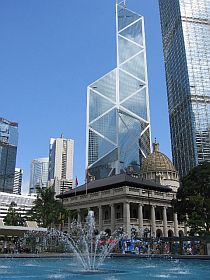
| BOC office in Hong Kong |

Bank of China (BOC) is one of China’s four state-owned commercial banks. It was founded in 1912 by the Government to replace the Imperial Bank of China. In 1994, the company was transformed into a state-owned commercial bank and was listed on the Hong Kong and Shanghai Stock Exchanges in 2006. Currently, BOC is the 9th largest bank in the world by market capitalization and the 4th largest by assets. It provides a comprehensive range of banking products and financial services to individual and corporate customers as well as financial institutions worldwide. Its businesses cover commercial banking, investment banking and insurance. The Group's members include BOC Hong Kong, BOC International, BOCG Insurance and other financial institutions. The company operates more than 10,600 domestic branches and outlets and 580 foreign offices in Hong Kong, Macau, Taiwan and 37 other countries. China's government owns about 70% of BOC. As of April 2017, Bank of China had a market capitalization of US$150 billion.
BOC Credit Cards:
Bank of China Great Wall International Debit Card
Great Wall International Credit Card (Issued in the UK)
Bank of China-China Southern Sky Pearl Credit Card
Bank of China JCB Credit Card
Great Wall Globe-in-One Credit Card
Key Statistics:
| Total assets | CNY 18.149 trillion (2016) |
| Operating income | CNY 485.656 billion (2016) |
| Profit | CNY 184.051 billion (2016) |
| Total Equity | CNY 1.412 trillion (2016) |
| Gross loans | CNY 9.973 trillion (2016) |
| Company Size | 308,900 employees (2016) |
| Website | http://www.boc.cn |
Head office address:
1 Fuxingmen Nei Dajie
Beijing 10081-8, China
Phone: (86) 010 6659 6688
Fax: (86) 010 6601 6871
Bank of China (UK) Limited
1 Lothbury, London EC2R 7DB
United Kingdom
SWIFT: BKCHGB2U
Phone: (4420) 72828888
Bank of China (Luxembourg) S.A.
37/39 Boulevard Prince
Henri L-1724 Luxembourg
P.O. BOX 721 L-2017
SWIFT: BKCHLULA
Bank of China (Canada)
Suite 600, 50 Minthorn Boulevard
Markham, Ontario, Canada, L3T7X8
SWIFT: BKCHCATT
Toronto Branch
6108 One First, Canadian Place
100 King Street West
Ontario, Canada, M5X 1C8
Paris Branch
23–25 Avenue De La
Grande Armee
75116 Paris, France
Grand Cayman Branch
Grand Pavilion, Commercial Center
802 West Bay Road, Grand Cayman
KY1-1204, Cayman Islands
New York Branch
410 Madison Avenue
New York, NY 10017, USA
SWIFT: BKCHUS33
Phone: (1212) 9353101
Website: www.bocusa.com