Banco Macro
 |
|
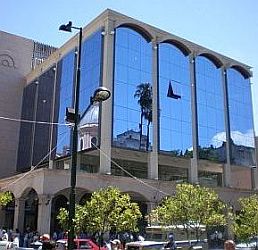
| Banco Macro head office |
Banco Macro S.A. (NYSE: BMA; Buenos Aires: BMA) is the fourth-largest private bank in Argentina with 3.5 million retail and corporate customers. It provides a broad range of standard banking products including checking and savings accounts, time deposits, Visa and Amex credit cards, personal and car loans, mortgage loans, overdrafts, home and auto insurance as well as corporate banking products, online banking and other services. The company was established in 1976 and, as of December 31, 2025, operated 444 branches, 2,016 ATMs and 922 self-service terminals nationwide. It was formerly known as Banco Macro Bansud S.A. and changed its name to Banco Macro in 2006. In the same year, it was listed on the New York Stock Exchange, becoming the first Argentine company to be listed abroad since 1997. In 2001-2010, Banco Macro acquired Banco Bansud SA, Nuevo Banco Suquía SA, Nuevo Banco Bisel SA, Banco del Tucumán SA and Banco Privado de Inversiones. In November 2023 the Central Bank of Argentina authorised Banco Macro's purchase of Banco Itaú Argentina S.A., which was renamed Banco BMA S.A.U. and merged into Banco Macro on November 14, 2024, ending Itaú Unibanco's presence in Argentine retail banking; the acquired securities and asset management businesses were absorbed by Macro Securities and Macro Fondos in September 2025. As of March 31, 2017, the company had total assets of Ar$ 166.992 billion, loans of Ar$ 94.1 billion, total deposits of Ar$ 115.2 billion, total equity of Ar$ 23.9 billion and employed nearly 8,700 people. As of May 2026 the Central Bank of Argentina recorded total assets of Ar$ 23.66 trillion and total deposits of Ar$ 13.90 trillion; the bank employed 8,490 people at December 31, 2025.
Key Statistics:
| Total assets | Ar$ 23.66 trillion (5/2026) |
| Revenue | Ar$ 19.930 billion (FY 2016) |
| Net Income | Ar$ 6.541 billion (FY 2016) |
| Employees | 8,490 (12/2025) |
Banco Macro subsidiaries:
Banco del Tucumán S.A.
Macro Bank Limited (Bahamas) (formerly known as Sud Bank & Trust Co Ltd)
Macro Securities S.A.
Macro Fiducia S.A.
Macro Fondos S.G.F.C.I.
Credit Ratings (May 2017)
Moody's | Long Term Debt: B3, Long Term Deposit: Caa1, Outlook Stable
Fitch | Long-Term IDR: B, Short-Term IDR: B, Outlook Stable
Head office address:
Sarmiento 447
1041 Buenos Aires
Argentina
Phone: +54 11 5222 6500
Website: www.macro.com.ar
Last updated